Mayo Clinic · Clinical research · Human oversight of AI
Let the agents do the work. Keep people in charge.
AI agents are planned to handle study startup paperwork across many systems. I designed how coordinators direct them, check their work and step in.
Let the agents do the work.Keep people in charge.
| Agent | Sites | Status | Actions |
|---|---|---|---|
| Imaging | DWNLKS | Needs review | Review |
| Pharmacy | DWNLKS | Agent working | –
|
| Logistics | Study-wide | Complete | View |
- File the study documents
Upload the protocol and any supporting documents. A protocol is required.
- Orchestration reads the protocol
Waiting on the documents.
- Logistics scope assessment
Waiting on Orchestration.
- Review and approve the agent plan
Waiting on the Logistics assessment.
Review and approve plan
Let the agents do the work. Keep people in charge.
* Screens updated for this portfolio. Names and data are not real.
Where it started
The real cost was typing the same study ten times
Every study ran through many disconnected systems, each with its own login and manual entry. 8 of 11 specialists surveyed named fragmented systems as a top cause of delay, and 9 of 11 said one shared tracking view would meaningfully change their work. Every one of them spent time each week chasing status that did not move a study forward. A status tracker I shipped earlier, nicknamed “the pizza tracker,” made the delays visible and showed where they started: at intake. That is where the fix had to begin.
“I would really love to not have to enter the same data into multiple places. That is the single biggest thing.”Research protocol specialist
The research
Six months with the people who activate studies
I set up standing research panels for the three roles that carry a study to launch: protocol specialists, research coordinators and activation project managers. I kept going back to each one with surveys, interviews, usability sessions, a card sort and prototype reviews, and mapped a persona and an activation journey for every group.
Each number is a different round: 45+ staff took part across the surveys, interviews and sessions; 17 protocol specialists sit on the standing panel; 11 specialists rated the concepts; and 5 tested the working prototype.
Protocol specialists
Status lived in too many places. Their top request in prototype reviews was one view of every study and who is covering it.
Research coordinators
Unclear task ownership and buried notifications were the main blockers. 6 of 9 rated a personal work queue “extremely valuable.”
Project managers
They didn’t want to manage studies in another tool. They wanted to stop chasing status by hand across parallel workstreams.
The direction
One front door for study teams, with agents doing the work underneath
I proposed the structure for the next phase of the product and scoped it to the stretch where three teams work in parallel and status gets lost: from the moment documents are ready to the day a study opens for enrollment.
A scope decision
One coordinator first, on purpose
In prototype review, a coordinator who runs investigator-initiated trials, where Mayo is the sponsor, could not find her work in the flow I had built. The other reviewers worked on industry-sponsored studies, and the prototype fit them.
The platform supports many study types and roles, and building for one persona first was a debated choice. I made the case for focusing on the coordinators who most directly drive activation time, the ones running sponsor studies, and the first build centers on them. Investigator-initiated trials still appear in the study list without their own designed flow.
It was a hard call to keep making. The build is now focused on that one coordinator. The cost is real: other study types and roles are not in the first build.
One source of truth
One set of rules as the build grew
When more teams joined the build, I mapped their workflows into the product’s navigation and kept the control model as the single set of rules everyone built against.
The control model
Once the software did the typing, the question became: who decides?
I ran guerrilla usability tests on each step with coordinators, then took the direction to leadership, who approved it. The model is simple: nothing moves from proposal to action without a person.
Key flows
Three moments where the coordinator decides
Set up, approve, correct. Rebuilt from the working prototype.
Coordinator · setup
A guide that says what it is waiting on
A Phase II Study Of A Combination Therapy In Patients With Advanced Non-Small Cell Lung Cancer
Agent Overview
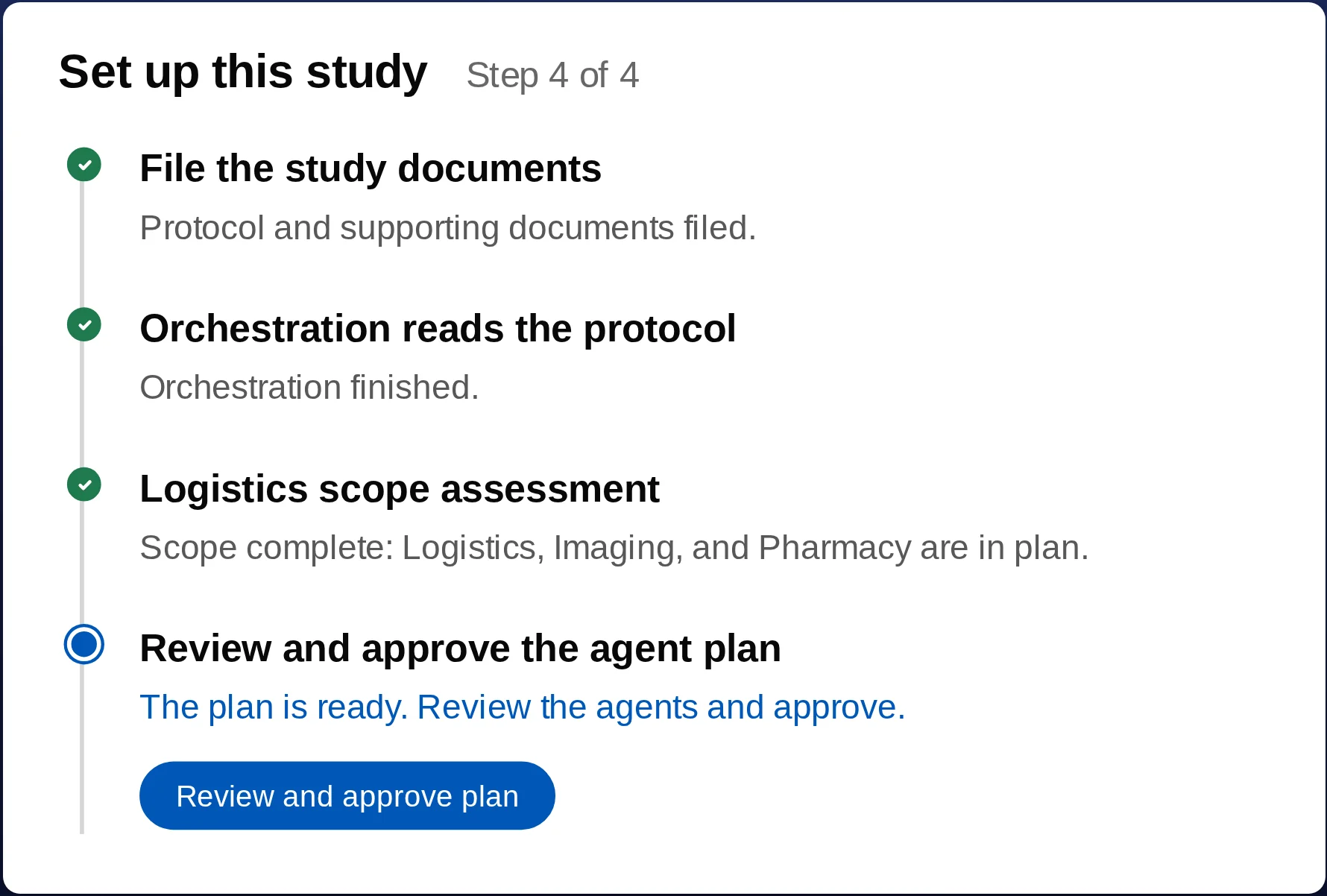
- File the study documents
Upload the protocol and any supporting documents. A protocol is required.
- Orchestration reads the protocol
Waiting on the documents.
- Logistics scope assessment
Waiting on Orchestration.
- Review and approve the agent plan
Waiting on the Logistics assessment.
Documents
| Document | Type | Description | Version | Date Uploaded | Uploaded By | Action |
|---|---|---|---|---|---|---|
| No documents have been uploaded. Use the upload section above to add documents. | ||||||
| 2026-09-24_NW-2291_Protocol_v1.pdf | Protocol | v1 | Sep 24, 2026 | Jordan W. | View Download Remove | |
| Investigator_Brochure_Ed3.pdf | Investigator Brochure | v1 | Sep 24, 2026 | Jordan W. | View Download Remove | |
Upload documents
Set a type for each file. A description is required only when the type is Other.
| Document | Type * | Description |
|---|---|---|
| 2026-09-24_NW-2291_Protocol_v1.pdf | Select type |
Optional Optional. Helps others identify the file. |
| Investigator_Brochure_Ed3.pdf | Select type |
Optional Optional. Helps others identify the file. |
Coordinator · the plan
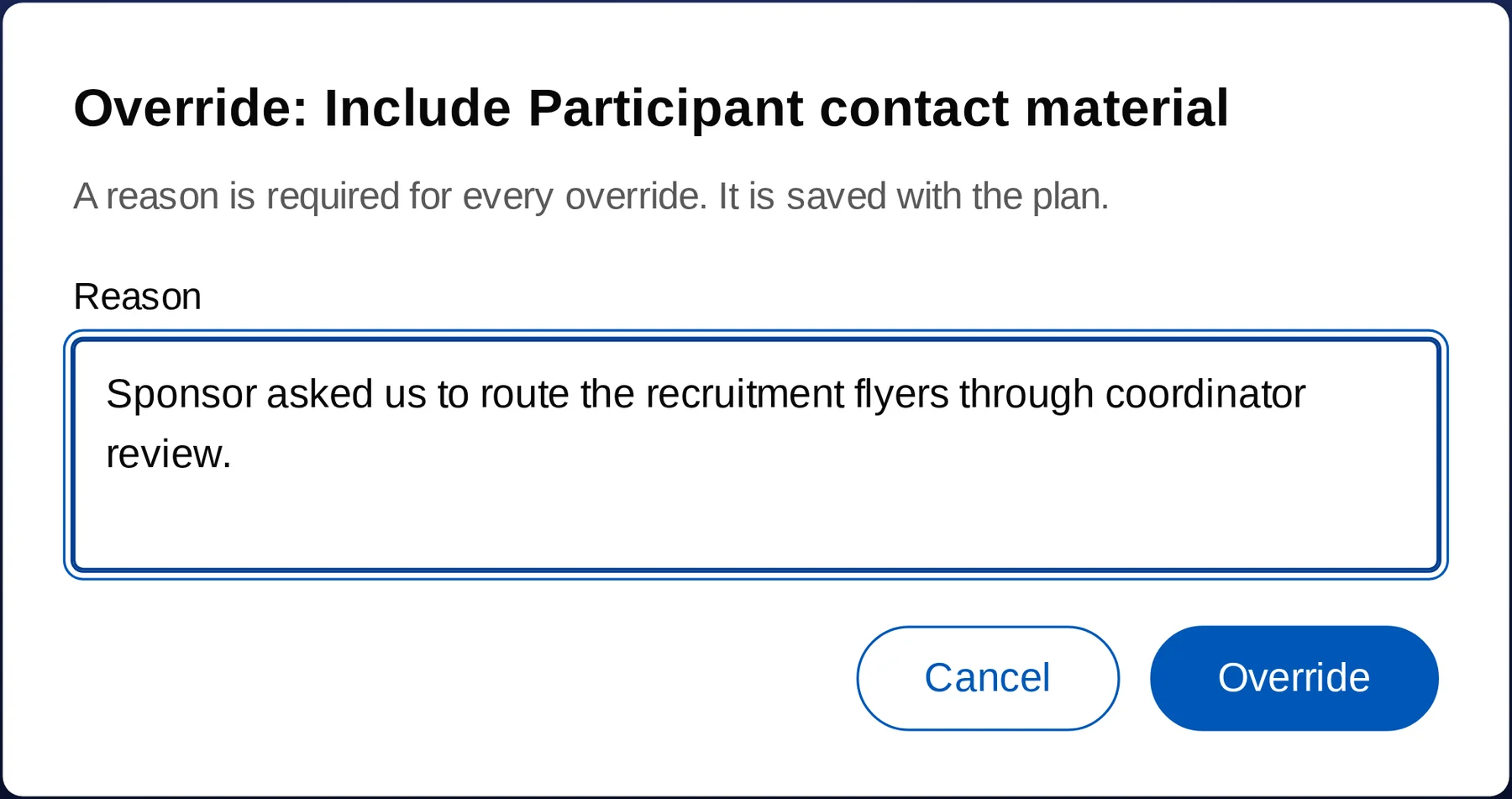
Every override carries a reason
A Phase II Study Of A Combination Therapy In Patients With Advanced Non-Small Cell Lung Cancer
Agent Plan
Agent Overview
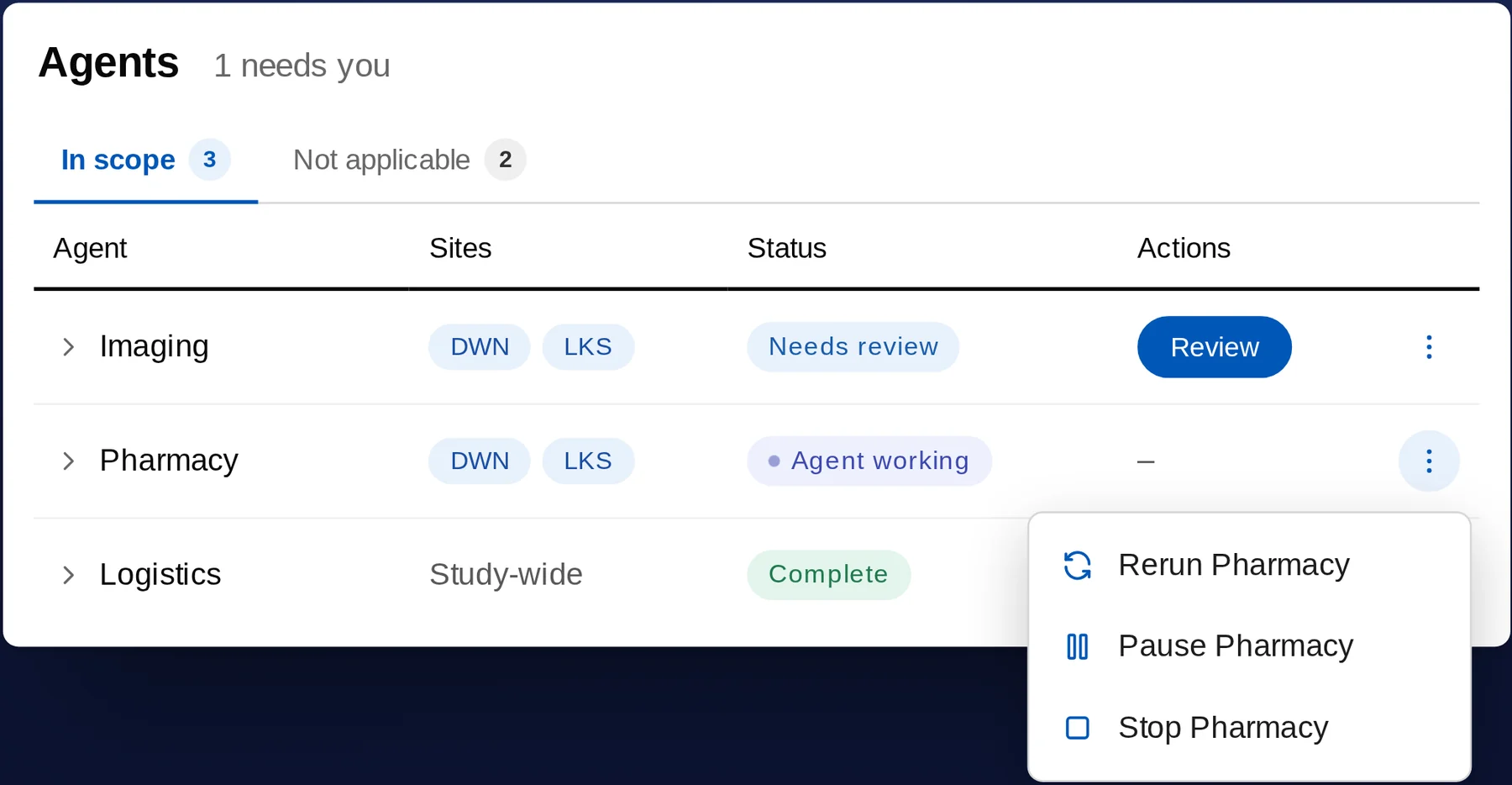
| Agent | Sites | Status | Actions |
|---|---|---|---|
| Logistics | Study-wide | Complete | View |
| Imaging | DWNLKS | Agent working | – |
| Pharmacy | DWNLKS | Agent working | – |
| Participant contact material | Study-wide | Agent working | – |
Override: Include Participant contact material
A reason is required for every override. It is saved with the plan.
Coordinator · review
Overruling the AI leaves a trail
A Phase II Study Of A Combination Therapy In Patients With Advanced Non-Small Cell Lung Cancer
Imaging
✓ SavedAgent actionsDoes the protocol require new imaging to be acquired as part of the study? *Edited
ConfirmHow often is tumor assessment imaging done? *
ConfirmedWhat changed, and why?
You changed the agent’s answer. A short note helps the next reviewer and is kept with this question’s history.
Three design moves
Details that make oversight real
Agents propose, people approve
The agents suggest which steps a study needs. Nothing runs until a coordinator approves the plan.
Stopping is as easy as starting
Pause, stop and rerun sit on each agent’s row, so stepping in never means hunting through settings.
Say whose move it is
Coordinators told me a name like “Waiting on Dr. Chen” hides what is really blocking a study. Waits now read by role, PI, Sponsor or Study Staff, and every party a study is waiting on shows at once.
Outcome
The in-house product team builds from my prototype, and requirements are written directly from it. A longtime research operations leader said they had waited 15 years for this.
What’s next. The control model is written so that whoever builds the agents, in house or a partner, builds against the same rules, from requirements written off my prototype. Bulk approval by confidence level is deliberately parked until workshops and testing show people review first. No agent has run in production yet, so the first measures are still ahead. Once the agents run, I plan to measure override rate and time per confirmation to catch rubber-stamping.